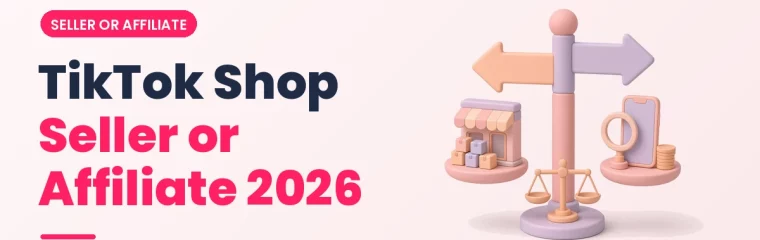
TikTok Shop seller vs affiliate comes down to what you own. A seller runs a shop and keeps the sale minus costs, while an affiliate promotes other shops’ products for a listed commission. In October 2026, the middle US shop in our top 500 sample sold 42,456 unitsS1. The middle listed commission rate on the top 200 US products was 14%S2.
Below are both paths side by side, what each looks like in one full month of FastMoss data for the US, and when the other path is the better pick. GMV figures on this page are FastMoss estimates. Seller figures are GMV, not profit. Affiliate figures are listed rates and estimates, not payouts.
Compare shop and product data in FastMoss before you choose a path.
TikTok Shop seller vs affiliate: is a seller the same as an affiliate?
No. A TikTok Shop seller owns a shop, lists products, ships orders and handles returns. An affiliate is a creator who adds other sellers’ products to videos or LIVE streams and earns the commission rate the seller sets on each product. The seller pays that commission out of each sale the affiliate drives. For the full mechanics, see how TikTok Shop affiliate marketing works for brands and creators.
| Seller | Affiliate | |
|---|---|---|
| What you run | A shop with your own listings | Content that links other shops’ products |
| What you need first | Products, stock, shipping and customer service | An audience and a steady posting habit |
| How you earn | The sale price, minus product cost, fees, commissions and returns | The listed commission on sales you drive |
| Main risk | Unsold stock and returns | Low sales on the products you pick |
| What to track | Units sold, GMV and margin per order | Units you drive and the listed commission rate |
Some people do both. A brand can run a shop and also post its own videos and LIVE streams, and many of the top LIVE sellers in the US are brand accounts.
Bottom line: These are two different paths, even if some people do both.
TikTok Shop seller vs affiliate: which path pays more in 2026?
Neither has a single answer, because the two paths earn in different ways. In October 2026, the top US shops by GMV had a median of $1,003,966 in GMV and 42,456 unitsS1. On the top 200 US products by units, the median listed commission rate was 14%, and the estimated listed commission per product had a median of $66,569 for the monthS2.
| October 2026, US | 25th percentile | Median | 75th percentile | Sample |
|---|---|---|---|---|
| Shop GMV (seller path) | $557,068 | $1,003,966 | $1,937,548 | 498 of the top 500 shops by GMV |
| Shop units sold | 33,315 | 42,456 | 60,174 | Top 500 shops by GMV |
| Listed commission rate | 10% | 14% | 15% | Top 200 products by units |
| Estimated listed commission per product | $43,338 | $66,569 | $113,312 | Same 200 products |
These two rows do not compare like with like, and that matters. The shop row is GMV for a whole shop before any costs. The commission row is a pool for one product, shared by every affiliate who promoted it, and it assumes every sale came through an affiliate. Real payouts are lower than that pool.
Bottom line: Payoff depends on the path and the sample, and both ranges are dated.
What does the seller path look like in the data?
A top US shop in October 2026 sold tens of thousands of units. The middle 50% of the top 500 shops sold between 33,315 and 60,174 units and the middle 50% of 498 shops made between $557,068 and $1,937,548 in GMV, after we left out 2 shops with an abnormal GMV per unitS1. Of those 500 shops, 179 were cross border shops and 321 were local shops.
These shops also leaned on affiliates. The median shop in the sample had 8,206 linked creators in October, and across the 495 shops with at least one linked creator and a normal GMV per unit, the median GMV per linked creator was about $152S1. So even large shops spread their sales across thousands of creators, and most of those creators drove small amounts.
GMV is not profit. A seller still pays for the product, shipping, platform fees, creator commissions and returns. Our guide to TikTok Shop seller costs in the US for 2026 breaks those costs down, so we do not repeat the numbers here.
Bottom line: Seller figures in this post are GMV ranges, not profit.
Open the FastMoss shop ranking to see shops in your category.
What does the affiliate path look like in the data?
On the top 200 US products by units in October 2026, listed commission rates ran from 1% to 40%, with a median of 14% and a middle range of 10% to 15%S2. The most common rates were 15% (60 products) and 10% (53 products). None of the 200 listed a 0% rate.
Here are three products from that sample, to show how the estimate works. Each one is a full month figure for October 2026.
| Product (shop) | Units sold | Listed rate | Estimated listed commission pool |
|---|---|---|---|
| Body care set (medicube US Store) | 210,672 | 15% | $987,519 |
| Magnesium supplement (Toplux Nutrition) | 116,409 | 25% | $502,031 |
| No underwire bra (OEAK Apparel) | 116,780 | 10% | $196,308 |
For a single creator, a closer guide is the creator side. The 500 creators in our October 2026 FastMoss creator ranking pull, sorted by LIVE GMV, had a median of $257,857 in total GMVS3. At the median listed rate of 14%, that would be about $36,100 in listed commission for the month. Some of those accounts are brand accounts selling their own products, so treat this as a ceiling for the top of the market, not a typical affiliate.
Bottom line: Affiliate figures are listed-rate estimates on a stated product sample.
How do the two paths differ by category?
Listed commission rates change more by category than shop sales do. In October 2026, Health products in our sample had the highest median listed rate at 20%, Beauty and Personal Care sat at 15% and Womenswear and Underwear at 10%S2. Shop units moved much less, with median top shops in those three categories selling between 45,773 and 51,053 unitsS1.
| Category (October 2026, US) | Top shops in sample | Median shop units | Top products in sample | Median listed rate |
|---|---|---|---|---|
| Health | 25 | 51,053 | 23 | 20% |
| Beauty and Personal Care | 142 | 45,773 | 84 | 15% |
| Womenswear and Underwear | 82 | 46,055 | 27 | 10% |
For an affiliate, this means the same sales effort can earn twice the listed commission in one category compared with another. For a seller, a higher listed rate in your category is a cost you need to plan for, because it is the price of getting creators to pick your product over others.
Bottom line: Check the listed rates in your own category before you choose, since they vary more than shop sales.
When is the other path the better pick?
Each path has cases where it clearly wins. Use these to test your own plan.
- Pick the affiliate path if you have an audience but no products. You can start without stock, test many products in a month and drop the ones that do not sell.
- Pick the affiliate path if you cannot handle shipping, returns or customer service. Those jobs stay with the seller.
- Pick the seller path if you already make or source a product with a healthy margin. A seller sets the price and keeps more of each sale than a listed commission of 10% to 15%.
- Pick the seller path if you want many creators working for you. The median top shop had more than 8,000 linked creators in October 2026.
- Do both if you have a product and can make content. Many top LIVE sellers in the US are brand accounts that sell their own products on their own streams.
Bottom line: The other path wins when your assets match it, so test both against what you already have.
Who should sell, and who should promote?
Match the path to what you already have. If you have supply, a way to ship and cash for stock, the seller path fits. If you have content skills and an audience, the affiliate path fits, and our guide on how to become a TikTok Shop affiliate covers the steps. If you are a seller who wants affiliates, see how to find TikTok Shop affiliate creators.
- Check your category in the FastMoss shop ranking and note the units of the shops in the middle of the list.
- Open three products you would promote and read their listed commission rates and monthly units.
- Multiply the rate by a sales level you think you can drive, and compare that with the margin you could earn as a seller.
- Recheck the numbers each month, since rates and rankings change.
Bottom line: Pick the path that matches your assets, then check the dated ranges above.
Browse FastMoss shop and product data
FAQ
Is a TikTok Shop seller the same as an affiliate?
No. A seller owns a shop, lists products and ships orders. An affiliate promotes other shops’ products in videos or LIVE streams and earns the commission rate the seller lists.
Should I be a TikTok Shop seller or an affiliate in 2026?
It depends on what you have. With products and a way to ship, the seller path fits. With an audience and no stock, the affiliate path fits. In October 2026, the median top 500 US shop sold 42,456 units, and the median listed commission on top US products was 14%.
How much do TikTok Shop sellers make compared with affiliates?
In October 2026, the top US shops had a median of $1,003,966 in GMV, a FastMoss estimate before costs. On the top 200 US products, the estimated listed commission pool had a median of $66,569 per product, shared by all affiliates on it. These are GMV and estimates, not profit or payouts.
Are affiliate commission figures the same as payout?
No. The figures on this page are the listed commission rate times the product’s GMV for the month. They assume every sale came through an affiliate and are shared by all affiliates on the product, so real payouts are lower.
Where do I learn how to become an affiliate?
Our guide on how to become a TikTok Shop affiliate covers the requirements and the steps. This page only compares the two paths.
Where do seller fees get explained?
Our guide to TikTok Shop seller costs in the US for 2026 covers fees, creator commissions, fulfillment and returns.
Sources
- S1. FastMoss US shop sales ranking, October 2026, top 500 shops by GMV, pulled November 16, 2026 for our sellers report and reused here. GMV percentiles use 498 shops after leaving out 2 with an abnormal GMV per unit. Percentiles computed by us.
- S2. FastMoss US product sales ranking, October 2026, top 200 products sorted by units sold, listed commission rate and GMV, pulled November 16, 2026.
- S3. FastMoss US creator ranking, October 2026, requested sorted by LIVE GMV, all 500 entries (the same pull used for our LIVE stats page), pulled November 16, 2026.