
We have all seen it: a messy video filmed on a potato gets 5 million likes, while a cinematic masterpiece sits at 200 views. For brands, creators, and e-commerce sellers, this unpredictability is frustrating. You can’t help but ask: What actually makes a video “viral” on TikTok today?
The harsh truth is: your intuition is outdated. On modern TikTok, “viral” isn’t a feeling—it’s a specific set of data points. While the naked eye sees a chaotic trend, professional analytics tools like FastMoss see a sophisticated pattern of engagement and conversion.
Let’s move beyond “guessing” and decode the true anatomy of a viral video using granular data.
The Intuition Trap: Why “Gut Feeling” Fails
In the early days of social media, “viral” simply meant massive views. But TikTok has evolved into a multi-billion-dollar e-commerce engine.
Today, a video with 10 million views that generates zero sales is a dud for a business. Conversely, a video with 50,000 highly targeted views that sells out a warehouse is, by every meaningful metric, incredibly viral.
TikTok’s algorithm does not care about your subjective “good production value.” It rewards watch time, engagement velocity, and conversion rates. To find what is truly viral, you need to stop looking at the surface-level videos and start analyzing the data engine powering them.

Step 1: Navigating the Sea of Content with Precision Filters
When you enter the “Ads” section of FastMoss, you aren’t just looking at a random feed of popular videos. You are looking directly at the heartbeat of TikTok E-commerce.
To define a viral video, you first have to define your specific playground. What is viral for a global brand isn’t the same as what is viral for a dropshipper. FastMoss allows you to filter the noise by Campaign Type:
Hot Product Ads: Videos pushing the physical items that are currently flying off the digital shelves.
Shop Ads: Content directly linked to TikTok Shop entries, built for immediate checkout.
Creator Promotion: Videos where influencers and affiliates are driving the narrative.
Commission Ads: Videos optimized specifically for the affiliate marketer ecosystem.

Categorization is Key to Contextual Virality
You cannot compare a viral beauty makeup tutorial to a viral power tool demonstration. Their baseline metrics for “virality” are entirely different.
Using the granular Categories filter, you can drill down into highly specific niches—from “Beauty & Personal Care” to “Womenswear,” or even hyper-specific tags like “Eye & Ear Care”. A viral video in a niche category like “Contact Lens Conditioning Kits” will inherently have lower total views than a viral fast-fashion clothing haul, but its conversion rate and audience intent will likely be substantially higher. Understanding this distinction is the first step in moving past the “big numbers only” mindset.

Step 2: Decoding the Metrics of True Virality
What does a viral video actually look like in the backend data? FastMoss provides a breakdown of “Advanced” metrics that define true commercial success well beyond the standard “Like” button.
1. The ROI Metric (For E-commerce Virality)
If you are running ads or selling products, virality is ultimately measured in dollars. FastMoss allows you to filter and sort videos by:
Est. Cost & Est. Conversions: How efficiently is the video acquiring customers?
ROAS (Return on Ad Spend): The ultimate truth-teller. A video is considered commercially viral if it maintains a high ROAS while scaling to hundreds of thousands of views.
2. The Engagement Velocity
If people are watching but not interacting, the video is a ghost. We look at:
Likes/Comments/Shares: The classic social proof, but viewed as a ratio to views.
Like-Follower Ratio: This is a hidden “secret” viral metric. If a video gets a massive amount of likes compared to the creator’s relatively low follower count, it proves that the algorithm is pushing the content hard to the FYP (For You Page), not just to existing fans.

3. The Creative Blueprint
Sometimes, the “viral” secret is simply technical. You can filter by Creative Attributes such as Video Duration or Resolution. You might discover that in your specific niche, the viral sweet spot is exactly 15 seconds long, or that videos using a specific CTA (Call to Action) Button perform 300% better.

Step 3: A Data-Backed Case Study – “The Travel Lady”
To truly understand how to identify a viral video, let’s look at a real-world example isolated by FastMoss data. Consider the “Women’s Leaf Print Off Shoulder Tie Front Romper” promoted by the advertiser Travel Lady.
On the surface, it’s a standard 35-second promotional video. Your intuition might say it’s nothing special. But let’s look at the “Ad Data Overview”.

By diving into the data, we uncover the anatomy of its success. The Video Play Trend chart shows a massive, sudden vertical spike on May 13th.
This is the literal, visual representation of a video “going viral.” It’s not a slow, steady climb; it’s an explosion of algorithmic attention. On that specific day, it generated a dense concentration of views, maintained a highly engaged audience (1.23% engagement rate), and delivered a powerful 3.12 ROAS.

The Consistency Factor: Virality is Rarely an Accident
A flash-in-the-pan video isn’t a sustainable business strategy; it’s just luck. However, if you look at the Ads Calendar, you can visualize how often an advertiser is posting and exactly which days trigger the most profitable activity.
Top creators and brands know that true viral success often comes from testing a “squad” of videos simultaneously over a month, waiting for the data to tell them which specific angle the algorithm loves, and then doubling down on it.
Step 4: Scalability – Finding “Viral Siblings” and Revenue Truths
Once you identify a viral video using data, the million-dollar question is: Can you do it again?
FastMoss allows you to look at Other Ads of This Product. This is where intuition goes to die, and data reigns supreme. Let’s look at the performance of different video versions for the exact same Romper:
Video Version A: Generated 581.5k views and brought in $3.4k in GMV (Gross Merchandise Value).
Video Version B: Generated only 281.1k views but brought in $5.4k in GMV.
Read those numbers again. The video with half the views made significantly more money.
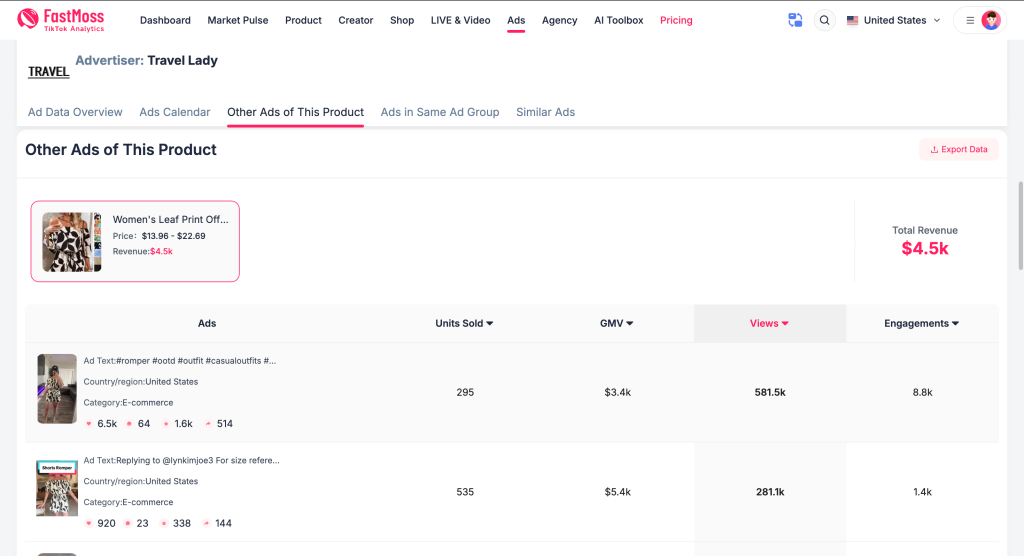
If you were scrolling TikTok and only looking at the public view counts, you would assume Video A was the “viral” winner to copy. You would copy the wrong video. The FastMoss data shows that Video B is the actual “revenue” winner. Its hook, pacing, and call-to-action were vastly superior at getting people to open their wallets.
Reverse-Engineering the Competition
To truly capture the viral lightning in a bottle, you don’t just look at one product. You search for Similar Ads. By analyzing what competing creators (like “PrettyGarden” or “WIHOLL FASHION”) are doing with similar jumpsuits, you can triangulate success. You can determine if the virality is tied to the product itself, a specific trending audio, the editing style, or the creator’s unique hook.

Step 5: From Analysis to Action – The “Viral Remake”
Finding the viral video is only half the battle; recreating its success for your own shop is the ultimate goal. Once you have identified a high-ROAS winner using FastMoss data, you don’t need to start your creative process from scratch.
If you look closely at the ad details in FastMoss, you will see a prominent “Viral Remake” button.

Clicking this button takes you directly from data analysis to content creation. It seamlessly redirects you to OUMOMO, automatically filling in the target video’s link so you can begin the remake process instantly.

Enter OUMOMO: Your AI Video Generation Powerhouse
OUMOMO is a cutting-edge AI e-commerce video generation platform that merges TikTok sales data with top-tier AI video models, including Seedance 2.0.
It is designed to solve the biggest bottleneck in TikTok e-commerce: content production. With OUMOMO, you can:
Generate High-Converting Videos: Use uploaded images, product links, or your selected FastMoss reference videos to create ads designed to sell.
Slash Production Costs: There is no need for real-life shoots, expensive equipment, or advanced professional video editing skills.
Scale Your Output: Produce high-quality, professional e-commerce content at scale, drastically improving your creative efficiency.
Conclusion: Stop Guessing, Start Generating
So, what is considered a viral video on TikTok today?
It is a video that achieves a statistical anomaly in watch time and engagement, leading to a measurable vertical spike in play trends. Most importantly, it translates attention into action—maintaining a healthy ROAS and driving actual GMV.
Your intuition might tell you that a video is “too simple” to go viral. But the data engine inside FastMoss does not lie. In the hyper-competitive world of TikTok Shop, the winners are the marketers who use sophisticated tools to see the numbers behind the magic, and then leverage AI to replicate that magic at scale.
Are you ready to find your next viral hit? Stop scrolling endlessly on your FYP. Filter the data with FastMoss, and generate your next winner with OUMOMO.